Category: Music Interviews

  • Misty River Ask Us To ‘Take This Dance’

    Misty River Ask Us To ‘Take This Dance’

    Misty River are a London based Americana band, comprising of Carmen Phelan and Adam Morley. They’ve just had their track ‘Take This Dance’ featured on Netflix’s ‘A Secret Love’. The track also appeared on the Oscar winning short ‘The Phone Call’.

    Socially distancing, I caught up with Carmen from Misty River, to find out ‘Take This Dance, the bands origins, staying authentic to Americana in London and future plans for releases once we return to the new normal.

    Hello Carmen! How the hell are you?

    Great, happy to be talking with you!

    Misty River have Irish and American roots, how did the band meet, what’s your history?

    We actually first met when we were kids, I’d just moved back to London from the States and met Adam’s younger sister at school who fast became my best friend. He completely ignored me as a kid (apart from laughing at my dress from Woolworths, my mother’s still furious). We were on totally different paths as teenagers, I studied classical music at a London conservatoire and Adam did popular music at Salford Uni. He graduated, I quit classical music and moved to Cork and then Kerry to play traditional Irish music but we met up again in London some ten years or so later!

    Your song ‘Take this Dance’ features over the credits of Netflix’s new documentary ‘A Secret Love’, how did that happen for you?

    By chance really. As it hadn’t been released but the video was on Youtube, I was shocked to find the film’s Director Chris Bolan had found it on the internet and decided it was good enough to go alongside tracks by Valerie June and Spoon. We were honoured to find it was used as the feature track at the end of the film.

    Take this Dance has also been featured on the Oscar winning short ‘The Phone Call’. When you wrote the song, did you think could have a soundtrack life? What do you think it is that makes ‘Take This Dance’ such a special song?

    It was one of those songs that kind of wrote itself, it just sort of popped into my head fully formed so it wasn’t obvious to me that it would be such a popular choice for sync placements. I think in terms of it connecting with people, I’ve wondered whether that may be related to its simplicity. I wasn’t trying to write anything clever or ground-breaking it was just an honest account of how I was feeling at a given point in time. The form is that of the trad. songs I grew up with, for example it doesn’t have a middle 8 or move beyond the
    original sentiment.

    Carmen, you grew up London but your Dad is from Ireland. How important is your Irish heritage to you?

    My Irish heritage has always been a massive part of my life, but I’ve always been surrounded by it. My father was very involved in putting on events at the Irish centre when I was growing up and we lived just around the corner from all his family. As my granny looked after me during the week whilst my parents were working I believe I’d a Dublin accent before I went to school. Moving to Ireland in my early 20’s on my own had a profound effect on me though, I really loved living there, I’d love to go back someday.

    Lockdown has changed many things for musicians, from the way you write music, rehearse and perform live. What changes have you as a band made to try to continue to push your musical life forward?

    My reaction to Lockdown has been very mixed. I’d love to say it’s been a period of unbounded creativity but it’s taken a fair bit of time to adjust and get past the initial anxiety of the situation. Being higher risk meant it started two weeks earlier for us than the official date. Watching the live side of the music industry melt away (alongside peoples livelihoods overnight) was and still is, a bit of a shocker. Musically, the roadmap has had to change for us and of course all the festivals and gigs have been cancelled including those booked to support the release of the first studio single.

    On the upside, I’m amazed at how fast people are adapting and finding ways to connect, write and perform. We do our first live stream this week with Rippla TV, I never would have imagined I’d be up for doing something like this in the past but now it’s becoming the new normal. The added bonus is that it will force me to brush my hair and get dressed properly, or at least the top half anyway.

    Is it easier or harder to write new material in these strange times?

    I think one thing that’s important to me as a songwriter is that what I write about is relatable and universal and of course that’s very much the mood of the moment. I’ve been thinking about the considerable contrast in peoples’ experiences during this time so some of that is definitely finding its way into the new material!

    The band has recorded its first full band release, will this be a series of singles, an album? How long did it take to record?

    We have an album worth of songs that we’ve have been writing over the last couple of years. They really came to life when we worked on them in Nashville with Vance Powell (Jack White, Chris Stapleton) and are a far fuller, bigger sound. The current plan is to release the first of the Vance tracks within the next couple of months followed by our debut EP. We are so excited to share it, the first single With You Arounds is a song about togetherness and seems even more important to share it at a time like this.

    Any funny stories from recording?

    Well funnily enough, when we started rehearsing songs for our record I sent the keys player a rough demo of one of the tracks, a loose, late night rough recording. His friend was making a small independent film and he intuitively felt that he felt the song was a good match so heforwarded on that late night demo without my knowledge. They replaced the Coldplay track they were thinking of using for my demo, and that little low budget film went on to win an Oscar. We didn’t even re-record the song as they were committed to the demo version.

    What three Americana albums would you suggest we listen to as a good introduction to the genre?

    It’s a pretty wide genre, it’s hard to choose. Whilst gender equality in terms of representation on radio and live is improving, its still a problem. I’ll take the opportunity to point you in the direction of some brilliant female led bands, Yola with her Walk Through Fire ( A black British artist that has taken the States by storm of late), Shovels and Rope, a husband and wife team fronted by Cary Ann Hearst with their awesome album O, Be Joyful and Brandi Carlile the artist and producer behind The Highwomen, an all female supergroup of sorts.

    As Americana artists, how do ensure to keep your authenticity, especially when you’re based in London?

    I think one reason so many people outside of the US are involved in making Americana music, is that it’s melting pot of so many culturesand traditions. It isn’t a static tradition. The music from Appalachia very much reflects the traditions of the immigrants from Ireland, Scotland and Scandinavia as well as of course the music of the black African musicians; they brought blues and hymnals as well as instruments including the banjo, to the region.

    What all of these traditions do share though is honest story-telling and an appreciation of song form accompanied by great musicianship. At the very heart of Americana is a tradition of travelling, hardship and adapting. As a kid I learnt to play fiddle from a Bluegrass player near to the Appalachians and then my family moved back to London and I went on to Cork, so it suits me very well to be involved in a form of music that finds unity from diverse musical and lived experiences.

    When the Lockdown ends and we get to the new normal, what venue are you most looking forward to playing in?

    We were due to play at The Slaughtered Lamb last month. We had our launch show booked there with a great grassroots promoter. I love the venue as the atmosphere and the sound are great, yet it’s a very unassuming place; Testimony to that are the amazing bands that have played (and continue to return to play) there even after achieving considerable success. But for the future, I’ve got my heart set on playing the Ryman Theatre in Nashville, made famous by the Grand Ole Opry. I’ve had the privilege of playing many beautiful theatres across the world as a touring musician but I never got to play there, so getting up on stage, in my own right, would be a dream come true.

    Who’s on your wish list of people you would like to collaborate with ?

    It’s a pretty long list – Certainly the Milk Carton Kids, Vampire Weekend, The Highwomen, Jack White to name a few!

    Have you picked up any skills during lockdown? How are your banana bread skills?

    I’ve a veritable smorgasbord of new skills that I’ve recently acquired and I’m seriously shite at most of them; these include making pizza, cutting hair whilst drunk, a wee bit of Spanish and yeah, Banana bread muffins. Shite, but I’m delighted with myself nonetheless.

    Send us a lockdown selfie?

    Carmen from the band Misty River, selfie outdoors on a step

    You can find out more from their website, Facebook Twitter and Instagram and stream their music on Spotify.
  • Blink’s Dermot Lambert Answers Questions About The Universe

    Blink’s Dermot Lambert Answers Questions About The Universe

    Formed in Dublin in the early 1990s, Blink became stalwarts of the Irish music scene. Dermot Lambert, Robbie Sexton, Brian McLoughlin and Barry Campbell signed to a major label, released three albums and toured America. They lived every young musician’s dream.

    Now, the band have just released ‘A Demo of The Universe’. Socially distanced, I caught up with front man, Dermot Lambert, to chat about the release, lessons learned in Blink and life as a solo musician and radio presenter.

    You’ve just released ‘A Demo of the Universe’, a collection of previously unheard demos, live tracks and alternate mixes from the ‘A Map of the Universe’ era, which was released in 1994. Why decide to release it now? I take it that this was decided before the world went weird?

    In truth this should have come out last year, being the 25th Anniversary of Map Of The Universe. I thought it would be nice to mark the occasion, but I was thinking more along the lines of a live show, then I got distracted by my own solo material, and I ended up performing some Blink tunes as part of my new live show, complete with 20 piece Mezzo Music Choir and the new band (Ian, Danni and Alice), which we still haven’t named. We’re working on a kicking live version of Cello for the next phase.

    Blink recorded three albums and it’s said you had recorded up to 100 songs in some form. This collection is 25 songs full, is there potentially another album’s worth of material?

    The tracks on this album had been recently digitised from various sources by a good friend Trevor Elliot, so I set about collating these older materials. There’s a lot of stuff, and the plan is to release at least another 1 album of about 18 tracks from the period between Map and The End Is High (1995 to 1998). We recorded an entire second album that was never released due to a variety of frustrating reasons.

    A couple of months after Blink played your first gig, you ended up in a studio with John O’Neill from The Undertones and Gil Norton. Are any of these tracks from those sessions?

    Those sessions are actually on A Map Of The Universe, believe it or not. Gil Norton produced It’s Not My fault, while he remixed Going To Nepal, which John O’Neill had produced alongside Dave Pine and Steve Hillage. Steve finished off the tracks that John and Dave started, so on one track (Christmas 22) I got Steve to play guitar, and I’d already gotten John to play on the same track, which meant we had a punk icon on the same song as one of the hippy kings – and I’m not joking when I tell you that nobody has ever been told this before! – no reason, there was just a lot going on – I might re-release the track so it states that they’re both featured on it.

    The calibre of who we were working with was never lost on me, I was totally enjoying what was going on. Chris Dickie was one of the engineers on the session, and he was working between us and Nellee Hooper while they were doing Bjork’s Debut, I was beside myself when I later heard that Bjork had the Blink album! Fanboy to the end.

    The version of ‘The Greatest Trick’ that’s included is from Wembley Arena when you were on tour with Crowded House. 1994 and the whole era was before digital storage. Asking as a bit of a nerd, how did you guys ensure that you managed to keep top quality masters of all these?

    DATS – everything is on DAT, I’ve always been a complete collector of this stuff. I also have about 300 cassettes of rehearsals going back through all my bands as far as 1982, you’d be amazed at how the quality holds up on these too. I also have some reel to reels, but mostly it’s impossible to access these, there’s not many reel to reel machines in working order these days.

    I need to ask the artwork for the album. It’s a really good companion to the demo-ness of the early recordings.

    My daughter Clare rattled this up using Corel on my PC, I asked her to copy the original, she’s just turned 9, and she’s thrilled to have something she’s done ‘released’. NERD FACT ALERT – The original sleeve was designed by Nick Seymour from Crowded House, and later reinterpreted by Steve Averill. Then when we released the album in America, the yanks completely hated the sleeve and that’s how we ended up with the ‘Eye’ sleeve, which none of us like, especially as the original sleeve was so feckin good!

    You signed to EMI, signing to a major label was a huge thing and it gave you the opportunity to tour in the US. What’s the biggest thing you learned from your time with a major label?

    It’s a different world, or it was then anyway. Nowadays you can record something quite cheaply and bang it out on Spotify, whereas in those days it cost so much to print vinyl or cassettes or CDs, and then get sleeves printed etc etc, and THEN try to get the thing played on radio!… I did all this for years with my two earlier bands Empty Shell and Rex & Dino, and it’s not for the feint hearted – I earned my indie stars I don’t mind telling you. The major label input is the difference between reaching a huge audience or not.

    We still maintained our independence while on the label though, we had total artistic control (hence tracks like Everything Comes Everything Goes and Normans Mom were allowed to stay on) , and we frequently refused to travel in Limos and 5 star hotels that they insisted on providing for us (the Irish office were never that silly). Christy Dignam later told me that was a mistake, and that we should have taken all that stuff, so the record company would spend so much money that they’d try harder to sell the band and get their money back (the famous word is ‘recoup’). I’m not sure which was the right approach, but we mostly had a great working relationship with EMI, and it helped us a lot.

    Listening to these tracks must take you back. Any stories you can divulge?

    So many stories, I should write a book. We had tons of fun, mostly very innocent. One of the best stories easily is what we called the Cup Game. Blink as a travelling unit was a very silly collection of people, reasonably educated, delusionally optimistic, and sometimes very very funny. The Cup Game happened in 1995, when we were travelling across America. There’s every likelihood that I started this.

    Here’s how it works, you have a cup of coffee in a takeaway cup, and when you finish it, you pretend you have to tie your shoe lace and ask the person next to you to ‘hold your coffee’. As soon as they take the cup from you, and they are then standing holding your empty cup, you make some sort of self satisfied face, laugh harder than the occasion really calls for, and set about ridiculing your friend for being such a total eejit as to fall for such a lame gag.

    On one of these occasions, the cup in question got passed to more than one person, and by the end of the day, we had decided that this indeed was the height of fun, and whoever had the cup at the end of the tour (three months) would have to buy everyone a pint. We all signed the bottom of the cup so that nobody could replace it with a fake, and we established rules such as no hiding the cup inside amps or drums, no throwing the cup at another person (it was essential that the person accepted the cup from you), you could hide the cup inside a jumper though for instance. Some of the best ‘cup passings’ included Robbie showing somebody something on a map, only to discover the cup was sellotaped to the back of the map.

    My personal best attempt was to buy a huge cup of Coke, empty out most of the Coke, put the cup in, and put the lid back on, I thought this was genius, but the problem with America is that it’s sunny all the time, and apparently the lads in the van could see straight though the Coke cup at the big empty mass with a bit of Coke on top, a bit like ‘Nothing To Declare’ and I was rumbled. It’s funnier than I’m telling it. In the end, we believe our sound engineer threw the cup in the bin because he considered himself slightly less silly than the rest of us.

    You’ve recorded your own solo material also and released an album ‘Tiny’, what are the biggest differences you’ve found from a band set up to working as a solo artist?

    I’ve played in bands since I was 17, and now I’m kind of back in a band again. There’s pros and cons. One of the big pros of being in a band is the camaraderie, shared goals means a lot. Maybe because I’m from a big family (11 kids). There’s songs that would never get written by an individual that can get written by bands (Cello for instance is a total band song). I enjoy both ways of working, and i feel I’ve produced some very good music in both settings.

    Are you ever really a solo artist or will you always be a member of Blink?

    When Blink exists I’ll be in it, but I like being Dermot Lambert too, I’m liking that more and more these days.Before Blink I had put two other bands together who did pretty ok. Empty Shell from 1982 to 1986, and then Rex & Dino from 1986 to 1990. I had always written and put my ideas into a band structure, and as such a lot of my best music lives forever in those bands catalogues.

    Recently I’ve begun to play some of my favourite songs outside of the band settings, and it’s very nice to be able to still play songs I wrote while in these bands. I do a gorgeous version of The Raven and The Tiny Magic Indian, not to mention my recent rendition of It’s Not My Fault with the Mezzo Ladies Choir. I also perform Christmas Forever with the choir alongside this, it’s a brand new song from what will be my next album later this year.

    You run the Garage Gigs in Ireland and present Garageland on RTÉ 2XM, promoting new Irish music, give us a tip for three acts we may not have heard before.

    I’d rather not give 3, because there are so many, and also because part of my job at Garageland is to not select favourites – it’s hard enough for them all as it is! But people are welcome to tune in every Monday at 7pm to hear lots of great new artists. I will say however, that I have been right at the forefront of discoveries such as Inhaler, The Wha, Magazines and The Script, so my humble finger on the pulse is often used to detect early vital signs by muso industry types.

    What venue are you most looking forward to getting back to when we get to the new normal?

    As a musician, I am bursting at the seams to play The Wild Duck again. It’s a really cool little venue, and then I really want to play the National Concert Hall with the new album.

    Got any jokes?

    Most of my adult life.

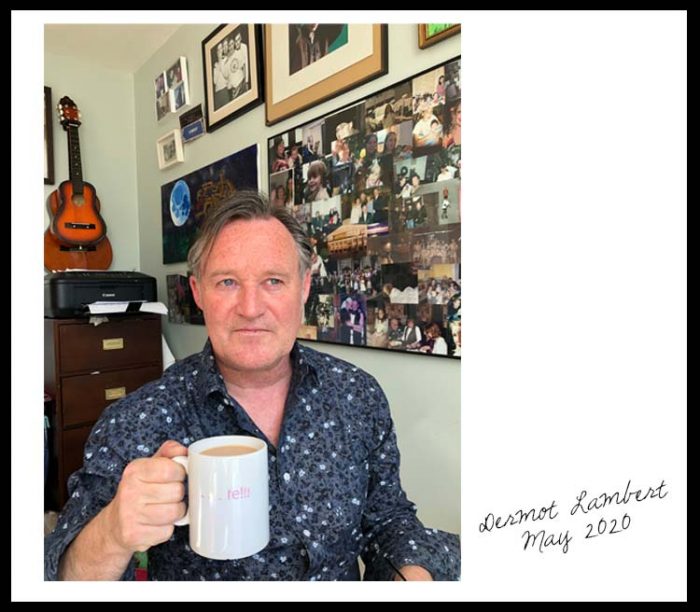
    Send us a lockdown selfie?

    Dermot Lambert with a cup of tea in his home office

    Find Blink online on Facebook and YouTube.

    Keep up to date with Garageland on their website, Facebook and Twitter and on radio every Monday at 7pm on RTÉ 2XM.

    Stream or buy ‘A Demo of the Universe’ here.

  • The Late David Turpin’s Offerings

    The Late David Turpin’s Offerings

    David Turpin is an enigmatic character. The softly spoken musician and screenwriter has been releasing music since 2008, under his own moniker and as The Late David Turpin following a near death experience.

    Four albums into his career, Turpin has released ‘Offerings (2008-2020)’, a collection of his favourite tracks from across his catalogue. The collection is only available for streaming and purchase for one day only, May 1 2020 on Bandcamp.

    I socially distanced while catching up with Turpin for a bit of a natter.

    Hello David, how are you today?

    I’m okay, thanks. With one exception, I haven’t spoken to another person face-to-face in six weeks, which has been a trip.

    You seem to have turned into the most prolific releaser of Irish music in 2020.
    So far you’ve released 2 singles (including ‘Burn Everything’ with drag artiste, Veda), 2 previously unreleased tracks including a cover of Bette Midler’s ‘The Rose’, one instrumental album and now.. a ‘Greatest Hits’. What was the catalyst behind these?

    I’ve released a lot of material over the years, and I also have a lot of unreleased material. I don’t like to look back at or listen to my own music, but being locked down on my own for the past six weeks, I’ve braved a backward glance and found that there were things I was actually proud of and wanted to share. ‘Greatest Hits’ is pushing it, though! I would diplomatically call it a ‘Retrospective Collection’. Perhaps somewhere in the infinite universe they were hits.

    Before even listening to the album ‘Offerings’, I can see from the titles that you seem to be influenced by the Greek and Roman classics and by the animal world. How do you join these together to be a happy partnership?

    That’s a very interesting observation, and I’m flattered you have made it. One of the texts that’s had a lot of influence on me is Ovid’s Metamorphoses, which is a compendium of classical myths related to transformation, often into animals. I think I’ve always been attracted to the idea of transforming into something else, perhaps because I’ve never felt at home in my self.

    Most artists will always prefer their latest work as it’s what they currently have a more emotional attachment to. How did you choose the tracks for the compilation?

    By memory at first, as I really don’t like listening to myself. In a way it was liberating never having had any ‘hit singles’ – if such a thing even exists any more – because I was free to choose the songs I liked. I haven’t always got it right, by a long chalk, but I think these 13 songs are ones where I got pretty close.

    ‘Offerings’ is only available to purchase for one day. Will we be able to stream it in the future or is it really a one day deal?

    I kind of like the idea of it being there for one day and then gone. Part of looking back is recognising one’s own impermanence, so in a way it makes sense that it doesn’t hang around.

    How do you describe your evolution or growth as an artist? We can all change a lot in 12 years.

    I think, for a lot of people, getting older is seen as a process of loss. But those parts of us that we think we lose – our ability to ‘play’ and to ‘daydream’, for instance – don’t disappear, they just migrate to other places. I’ve tried to keep in touch with them by remaining curious. That’s why, as time has gone on, I’ve worked more and more with other people, and other vocalists.

    If you could write to your 12 year younger self, about to release your first album, what advice would you give.

    I’m not sure that I’m in a position to advise anybody, least of all myself. I might tell him not to listen to creepy middle-aged men, including the one claiming to be a future him.

    You have worked with an amazing array of musicians and singers on your records. If you could write up a wish list, who would like to collaborate with?

    For me, it’s less about particular individuals I’d like to work with, and more about kinds of ‘otherness’ I would like to be in contact with. I’d like to work more with vocals in non-English languages, for instance. I would also like to be able to work more with older singers. We don’t often hear the voices of the ‘aged’, aside from a few canonical figures, and it’s a shame because we are losing out on a great deal, sonically, texturally and thematically, by privileging the ‘young’ voice over all others.

    I hear that ‘The Lodgers’, the film you wrote and scored is also getting a soundtrack release? It’s not often artists get to meld their two different disciplines like that.

    Yes, it’s getting a digital release via a UK label called Burning Witches, and there’ll be a vinyl release to follow. The bulk of that score was by Stephen Shannon and Kevin Murphy, and I just kind of floated in and out. It’s hard with a film because the writer is the first one on, and the music team are the last ones off. So if you do both, you’re with it for a very long time. Being honest, I probably wouldn’t do it again.

    How do you separate screen writing and making music. Are they different types of artistic cravings?

    They’re different animals entirely. I am mainly working on film projects at the moment, and I do find myself longing, at times, for the freedom of doing music. Film can be a lot more circumscribed. But when you manage to navigate within that and still preserve what you wanted to say, it can be incredibly satisfying.

    What three films would you recommend we watch this weekend?

    Maybe the most useful thing to do is to recommend things that are easy to access. I know a lot of people have recently subscribed to Disney Plus, so I would recommend the original and best, Snow White and the Seven Dwarfs, which was the first film I ever saw, and which continues to be somewhere in the roots of everything I do. If you’re using Netflix, I would recommend another classic, Blue Velvet. I think it’s one of the best American films of the 1980s, and time hasn’t dimmed its power: it’s still as scary, as sexy, and as strangely humane as ever. For people using Amazon Prime, one of the hidden gems there is a 2006 stop-motion animated feature by Christiane Cegavske called Blood Tea and Red String. I watched it late one night and was mesmerised by its power.

    What are you working on (musically or filmically) right now?

    At the moment, I’m working on a lot of film projects. I’m also beginning to develop my first feature to direct, which is something I’ve needed to do for a while. It’s a long road, of course, but I’m making a start.

    Have you any new film material or music releases planned for the rest of the year?

    Well, the Covid-19 crisis has changed a lot of plans in the film industry. The last feature I wrote, The Winter Lake, will be coming out soon, but it’s hard to say any more until we know how the situation develops. I’m looking forward to people seeing the film. It’s a mystery starring Emma Mackey, who I think is a very interesting actress.

    What have you learned about yourself during lockdown?

    I remain a mystery to myself. But I think lockdown has simple lessons to teach us all: Try to be considerate of others even when they aren’t there to remind you; try to be more comfortable in your own company; and if you need to have a wank, go for it.

    Finally, can you make banana bread?

    Any cooking involving bananas unnerves me. I remember once a man coming into my school to talk about first aid, and he told my class that – within the column of bone – the spinal cord itself has the same consistency and fragility as a banana. So now I can’t eat bananas without shuddering.

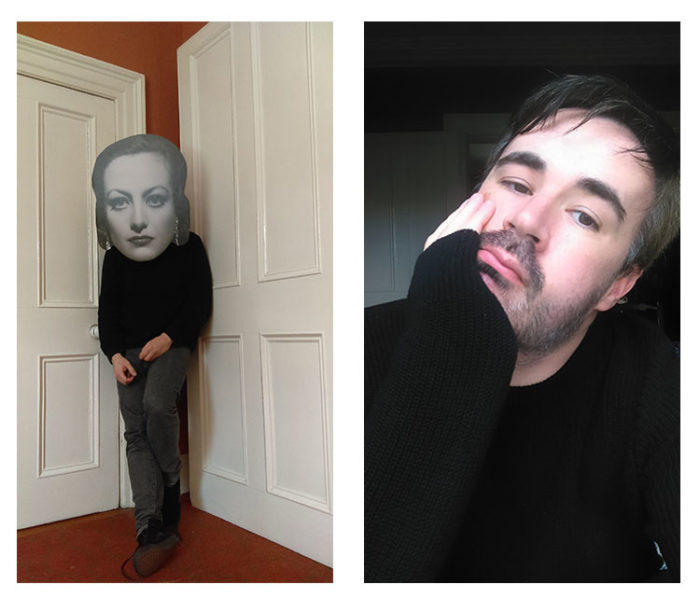
    Send us a lockdown selfie?

    I daren’t, but I shall.

    The Late David Turpin Selfies

    EDIT May 4 2020: Since May 1 has passed, David has actually made the track ‘Pony Tears’ available as a Name Your Price track on Bandcamp

    Find David online:
    thelatedavidturpin.com
    twitter.com/latedavidturpin
    facebook.com/thelatedavidturpin

  • Interview with Singer Songwriter, Alan Bonner

    Interview with Singer Songwriter, Alan Bonner

    Interview with Alan Bonner

    Alan Bonner is a singer songwriter who has just released his EP, ‘​Songs In The Key of Sea – The Galway Bay’​, which was,  suprise!, recorded in Galway. He has previously released three albums.

    Where are you right now ?

    I’m in Brighton, England. in the beer garden of the pub I’m living above.

    You describe yourself as a ‘wandering troubadour’ and you recorded your EP in Galway. There’s even a nod to the studios in the EP title. What was the reason that you choose to record there?

    Yeah I can’t sit still for long. That term probably sounds a bit wanky but it looked good on paper at the time. I had been visiting Ireland on tour several times over the years and totally fell in love with Galway, as its such a special magical place. I had made friends there too and from the first time I set foot in the place I had a gut feeling I was supposed to be there for a while at some point.

    I’d been living in Berlin for a couple of years and things in my personal life had got a little messy so I decided it was time for a change of scene. I’d always felt a pull towards Ireland so I packed up and went over to Galway for the summer last year to make the record. It was a brilliant time and just something I needed to do.

    You used some local musicians / producers. Had you worked with them before?

    I had played gigs in Galway with Pa Reidy when I’d come to Ireland on tour a few years back and also toured in Germany with Tracy Bruen. Both are friends of mine and I’m in awe of both their voices and their musicianship. They put me in touch with Will O’ Connor (Willow Sea) who produced the record and who is an absolute gent and we hit it off straight away.

    Niamh O’ Connor who plays cello was put in touch with through a friend of a friend. When it became clear I was moving to Galway to do the record I knew I wanted local talent on it with me as well. There’s so much talent in Galway, and we had a blast doing it.

    As a song writer, you need to be open and honest so that your lyrics and music resonate with people. If it were me, I would get quite anxious opening up like that to other people but you need to if your music is to have a life of it’s own. How do you separate Alan, the guy who gets up on stage and sings, and Alan, the private guy who opens his heart when writing?

    To be honest, I don’t think they are separate people. My stage persona is an extension of myself. Music allows me to express myself very honest way and yes, my writing is quite confessional and I do feel a bit exposed sometimes. I feel like that’s when people relate to it the most.

    It’s about holding a space where you can be vulnerable and let yourself be seen, so that people can relate and feel less alone in themselves or in the things they are going through, it allows for me to connect with them more. I don’t really know how to write any other way.

    There are times when I feel naked on stage because of the things I’m singing about but it can also be really empowering to show your vulnerability. There is strength in that, and I think it’s ok to show that you are human and that there are chinks in your armour.

    As a solo artist, how do find working with other people on your work? Do you find it challenging?

    No I love it. I am not deluded enough to think that all my ideas are good and I find bouncing off other people really inspiring. It stops me getting bored of myself.

    Songs in the key of sea EP CoverThe production is quiet stark on the EP and is different to 2016’s Night Music. Was this due to the lyrical content and themes in the EP or is it purely you progressing as an artist?

    It was a conscious decision to make a record that was totally different sonically to Night Music, both records deal with different themes and reflect different periods in my life. I knew I wanted to do something very understated this time as Night Music has a lot of production on it and quite synth heavy.

    Also, I think being in Ireland, being on the west coast and the delicate nature of the songs, inspired a stripped back approach and let the songs breathe a bit. The songs on the EP deal with a lot of grief and I think big production this time round would have been inappropriate. For the next one I’ll pull out all the bells and whistles. I like to mix it up.

    Some people write when they’re happy, others can’t, they need to be sad. What inspires you to write and play?

    Usually some kind of heartbreak or emotional distress has me reaching for the keys. I too struggle to write happy music, usually there is something I need to get off my chest. However there have been one or two happy songs. “Tiergarten” from the new EP is one of them. I write love songs to my friends, that kind of thing. I’m a bit of a soppy git like that. Travel inspires me a lot to.

    You’re based in Brighton but spent some time in London. Brighton is only an hour away but why did you get out of London?

    I left London 3 years ago to move to Berlin, then after a couple of years there I ended up in Ireland. I had lived in London 13 years on and off and just needed a change of scene. I lived in Brighton for a period 10 years ago when I was at music school down here and when I returned to the UK it seemed like a good place to come back to and I love being by the sea. I love though and always will. It was a huge part of my life.

    It’s 10 years since you released your first album, have you planned anything special for yourself to celebrate?

    To have a 10 year anniversary celebration for an album that was relatively ignored on release seems a little self indulgent so probably not but I never released the title track as a single and I always wished I had so maybe I’ll do that . We’ll see.

    You gig a lot. When you’re on the road what’s the one thing you can’t leave behind ?

    A good book and a good bottle of Red. I cant handle flights or bus rides without something to read and a little something to take the edge off.

    What 5 albums have shaped your musical life?

    There have been many more than 5 but heres a few

    David Bowie – The Rise and Fall of Ziggy Stardust and The Spiders from Mars

    Tori Amos – From The Choirgirl Hotel

    Fleetwood Mac – Rumours

    Rufus Wainwright – Want One

    Abba – The Visitors

    If you could have any producer sprinkle their magic fairy dust on your music, who would it be? Who could you trust?

    So so so many… difficult question. Probably Tony Visconti he is a god or maybe the guy from The National as l love his band and I love how he produced Lisa Hannigan’s ‘At Swim’ album. A beautiful record.

    What’s the one thing you would change about the music industry?

    Make it more about art and less about money. If I had my way X factor and all shit that came after it would never have been a thing. I have nothing against those kids who go on those shows some of them are really talented and they have balls, but the music industry now is about Saturday night entertainment TV more than it is about real music.

    It’s about how many followers you have on social media, over how good your record is. It’s become all about branding and marketing and money rather than real artists being supported and given the chance to develop and have longevity.

    There is brilliant music that will never get close to the publics ears because it will never be allowed on radio or on TV or because it will never get label support because it isn’t seen as being sellable enough so it falls through the cracks. Bit of a rant there…sorry!

    Here’s a few toughies for you:

    What’s the most rock n’ roll thing you’ve ever done?

    It cant tell you that , its far too incriminating for print. I don’t trash hotel rooms though. Its cliché and disrespectful and I could never afford the bill.

    What would you cook on Masterchef?

    I can’t cook for shit. It’s a running joke with my friends. Probably an average Spaghetti Bollegnese but I’d ply the judges with wine first so they wouldn’t mind.

    Who would play you in the movie of your life?

    Aw jesus, James MacAvoy…maybe? Or Cillian Murphy? Both are great actors and both are far better looking than I.

    What was the last lie you told?

    That I was only going out for one drink.

    .

    You can find out more about Alan on his website, Facebook, Twitter, Insta and Spotify.

    Alan’s next London gig is on June 17 in The Spice of Life in Soho.