Category: Living

Ah, Life! Life in London, tips for Irish people living outside Ireland, Irish people in Great Britain, LGBTQ stuff and various rants!

  • Community Groups // Why You Shouldn’t Kill Your Online Meetings

    Community Groups // Why You Shouldn’t Kill Your Online Meetings

    Why You Shouldn’t Kill Your Online Meetings

    I live in London. On July 19, 2021, so-called ‘Freedom Day’, any remaining restrictions were which were in place due to the Covid-19 pandemic were lifted by the government. Just because restrictions were lifted doesn’t mean that Covid has gone away. I want to share with you why you shouldn’t kill or abandon your online meetings for your community groups.

    I’m not here to have discussions with anti-vaxxers about how restrictions took liberties away. I’m speaking from my point of view as someone who started running and coordinating online events during Covid for a community group. As Chair of the London Irish LGBT Network, we decided last year to have our AGM online. Subsequently, I ran monthly online meet-ups with members. There are a few things I learned from this.

    Adapt To Your Audience or Community Group

    With all the respect in the world, your community group may be the centre of your world, but for others, it may just be a casual meeting or engagement. You can’t force anything on anyone. Each person will go to an event if they want to or won’t if they don’t. Simples. But expecting people to go to a meeting on a cold January night at 7 or 8pm is asking a lot. I mean, a duvet and hot chocolate sound better than traipsing across London in the cold rain or snow.

    As lockdowns have shown us, it is not always possible to physically be involved with a community group or organisation and this can be for a number of reasons and not always a lack of interest or will. To ensure that our community groups remain relevant and attract relevant participants, we must adapt.

    People have jobs. Work shifts can often inhibit their ability to attend in-person meetings. Physical meetings can clash with your evening or night shift or even your sleep and family time. Online meetings can enable these community members to still be involved and attend your meeting.

    One of the many things that Covid taught us is that we already had communication tools but never used them to their full potential. Skype, Google Meeting and Zoom all existed before Covid. They were just sitting there, on our phones, on our computers. We already had the tools, we just didn’t bother utilising them for what they were made for.

    Connected Earth // Why You Shouldn't Kill Your Online Meetings - nessymon

    Is Physical Location Important?

    Despite being a local community group, there’s absolutely nothing to say that your event or group won’t attract interest from people in far-flung corners, whether it be down to a shared interest in a topic or like ours, part of the global Irish diaspora. We’ve had people from all over the world join us for our meet-ups. We never would have had the potential to reach so many people with similar interests, outlooks, and life experiences if we had held physical meetings.

    Not only is it great for the group to say that we have an audience around the world, but it’s also good for other members of the group. At the start of each meet-up, I act as host and welcome people to the event. We encourage interaction and I always thank people for joining us and ask how their day was or what they’re up to in their part of the world. Introducing a little bit of chat or banter beforehand gives a glimpse of people’s personalities, interests etc. leading to a possibility of new connections and friendships

    With online meeting apps, we all have the ability to have our names displayed. This gives us the opportunity to present ourselves as we wish. We can show our names, pseudonyms, and pronouns. For shyer folk, they also have the option of joining in and finding out what’s going on, without having to reveal themselves on camera.

    Creating a Safe Space

    I also created a privacy policy, to enable a safe space for the group. This is vital as the group serves the LGBTQ+ community. Everyone is entitled to be respected and free to express themselves within the group. Also, the ability for newbies or those of nervous disposition to attend an online event is still there but if they’re not comfortable with being on camera, they can just keep it turned off.

    Also, we never know what a person’s home life is like. Your community group may be the only place where they feel safe enough to be themselves. It may be an escape

    Man wearing a protective mask to protect against coronavirus - Why You Shouldn't Kill Your Online Meetings - nessymon

    People At Higher Risk

    Throughout the pandemic, since March 2020, we’ve been told to keep our distance, avoid being stuck indoors with others, keep a room well ventilated. Since then we’ve been extremely lucky to have science bring us vaccinations to reduce the effect of Covid on us if we are unlucky enough to catch the virus.

    Since July, many people here in London have abandoned masks, even if mandatory on public transport, social distancing is a thing of the past and to many, it seems that the past eighteen months never happened. But, for a section of society, that is not the case. Those of our community who are immunocompromised are still susceptible to Covid and at higher risk of complications.

    For these people, meeting indoors with a group of unmasked people in a room with potentially little ventilation is a no-no and still not worth gambling with their health. Other people, though, have heart, lung, or blood conditions, may be undergoing cancer treatment or have other autoimmune conditions.

    These people are still valued members of our groups. Their needs cannot be overlooked. Just because some of our group are now happy to abandon their masks and take their chances, doesn’t mean that that is an option for other members of the community group.

    A Coffee cup on a table at a meeting with participants out of focus in the background - Why You Shouldn't Kill Your Online Meetings - nessymon

    Final Takeaway Points

    In March 2020, many vulnerable people were advised to isolate to protect themselves from the unknown Covid. We all went online, chatting talking catching up with friends. But now, as always, it is up to us to ensure that the vulnerable members of our community groups aren’t cast aside and forgotten like they so often are in the real world.

    I know there’s nothing like actual face-to-face human interaction. We’ve all come to value it and we need it for our mental health. But, before you get to abandon your online meetings, ask those in your group if physical meetings are really what they want, especially coming into winter. Online might just be safer for those more vulnerable or those who are unable to leave their homes, for whatever reason.

    During lockdowns, we reassessed how we do things. Many of those changes should have been implemented before Covid was even a thing. Just remember, your community group exists because your members have an interest in what you are doing, the events online and in-person that you run and because it gives a sense of belonging. Ask them what they want, ask them what they prefer to do. Your group is nothing without them.

  • Don’t Pay for a Passenger Locator Form // Covid-19

    Don’t Pay for a Passenger Locator Form // Covid-19

    Don’t Pay for a Passenger Locator Form

    23/09/21

    Since earlier in 2021, it has become a legal requirement for everyone going into Ireland to fill in a Passenger Locator Form. The same applies to many countries. But, you do not need to pay for these.

    When you book travel, you will be asked / advised to ensure you have all the correct documentation for your trip by your carrier. When you’re going into Ireland, depending on your circumstances, that means proof of vaccinations, proof of a negative RT-PCR test and your Passenger Locator Form. You can always find a list of everything you will need on the Irish government website, gov.ie

    You’ll also need your travel documents, i.e. passport, driving licence or ID. You can find out all you need about travel documents in this blog post ‘Travelling between the UK and Ireland // What Travel Documents do I need?’

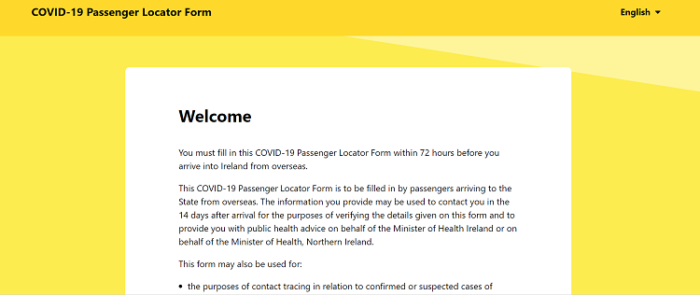
    Screenshot of Irish Passenger Locator Form from travel.eplf.gov.ie

    Dubious Passenger Locator Form Websites

    A Passenger Locator Form is a document that is required to be completed by the traveller into a country. This normally includes, your name and contact details, address you’re staying at, how and when you came into the country and the duration of your stay. At time of writing, it is a legal requirement to complete a Passenger Locator Form when entering Ireland from abroad.

    You do not need to pay to complete a Passenger Locator Form (PLF). These forms are free and are available from the websites of the countries governments who require them. There is no charge for them and there is definitely no charge for filling in an Irish Passenger Locator Form, which can be found here on travel.eplf.gov.ie

    However, as with everything in life, there is always someone somewhere who thinks they can make a quick buck. Unfortunately, during the Covid-19 pandemic, this is rife. There are a number of websites which have set up with the intention of making the unsuspecting traveller pay a fee for the privilege of filling in a passenger locator form. Please do not do this, it only encourages these people. There’s no need to pay someone for this.

    Don’t Pay Someone Else To Fill In A Passenger Locator Form

    Only use official government forms. If these people are going to fill in a PLF for you, you need to give them all the information. You need to give them this information on their website. They will then copy and paste your information into the Irish government Passenger Locator Form and you’ll be quids down. You

    Some of these websites charge between 27-35 £/Euro. Each traveller over 18 must fill in their own individual form. So, for a couple that’s an extra 50/70 quid for the pleasure of filling in a form. Remember, the details you just gave them are the same details you could have filled in yourself on the real form!

    Would You Give A Stranger Your Passport and Bank Details?

    Also, and here’s the concerning bit for me. These companies have been set up to ‘provide a service’. If people are unfamiliar with the internet or are unsure of exactly what they are looking for, they become easy prey for these companies. I’m not saying that they are scammers, it seems that they do actually fill in the form. But, as well as having all your details, name, address, date of birth, passport number etc., they also now have your bank details, which for me is a major issue. Just think of the potential for data protection breaches.

    The bottom line is you don’t have to pay to get yourself a Passenger Locator Form. You can fill it in yourself. The Irish one can be found here. If you fill in a form on a website where you pay to get a PLF, you don’t know what they do with your data. Bottom line, they now know everything about you and have your bank details.

    Do your research. Only use a form from an official government website. You don’t want your holiday turning into a nightmare!

    If you’re Irish or going to Ireland and have any doubts about what you should do, always contact your local Embassy or Consulate for advice.

    Photos from Pixabay.

  • Safe Home Ireland // Home Thoughts From Abroad

    Safe Home Ireland // Home Thoughts From Abroad

    Safe Home Ireland – Home Thoughts From Abroad

    I don’t often get the chance to chat about myself really (which is why I should probably blog more).So, when the nice folk at Safe Home Ireland, asked if I would like to take part in their ‘Home Thoughts from Abroad‘ series.

    From their website: ‘Safe Home Ireland is an emigrant support service. We provide advice, information and housing assistance to people who are thinking of returning or moving to Ireland.’ You can read more here.

    When I’m interviewing people for my radio show, I often do draw from my own experiences when asking questions but an interview isn’t about the interviewer, it’s about the person being interviewed. Which is why, I guess, when I do write anything about myself I often wonder if it’s the correct thing to write or if I should stay shtum about a subject.

    Realistically, I’m too old for that crap anymore. If you like me, you like me. If you don’t, well that’s none of my business. There are more important things to worry about in the world.

    Ireland From Afar

    So, that meant that I really enjoyed sitting down and answering all the questions posed by Safe Home Ireland. It also made me think a lot about Ireland, possible returns to Ireland in the future and if, indeed, I ever would permanently live there again. I don’t have a crystal ball. No one can predict the future but it definitely got me thinking about my relationship with Ireland.

    But all those thoughts are for another day. Right now, I’d recommend you grab a cuppa and head over to Safe Home Ireland for a nice read. Thanks to the the gang at Safe Home Ireland for letting me share my musings.

  • I was on LMFM:  ‘heartache of not coming home for Christmas’

    I was on LMFM: ‘heartache of not coming home for Christmas’

    I was on LMFM: ‘heartache of not coming home for Christmas’

    I was a guest this week on LMFM, our local radio station in Ireland. The regular presenter, Michael Reade, was being covered by an old friend, Ken Murray, which was a pleasant surprise.

    Being in London this Christmas sucks. A Lot. Not just for me but for a lot of people. Keep an eye for a blog post over the next few days.

    Have a listen. Thanks to Marie, Chris and of course, Ken for having me on.