I’m hosting a Q&A with Riyadh Khalaf for London Irish LGBT Network
As some of you may, or may not know, I’m currently Acting Chair of the London Irish LGBT Network. Our virtual AGM is on Thursday 22nd October. The way the world is right now means you need to reserve your tickets for the event and you can get tickets here
As part of the AGM, I’m delighted that I will be hosting a Q&A with broadcaster, author, Celebrity Masterchef Champion and all round good egg, Riyadh Khalaf.
Riyadh, who grew up in Bray, Co. Wicklow, presented the BBC series ‘Queer Britain’ and is also the author of ‘Yay, You’re Gay! Now What?: A Gay Boy’s Guide to Life’.
He also has been a regular on BBC Radio 1, Co-hosted on the sofa on The One Show as well as hosting, the naughty ‘Unexpected Fluids’ podcast and ‘Obsessed with Normal People’ with Evanna Lynch.
He’s also a social media king with over 380k followers on YouTube and, if you ask me, the future successor to Graham Norton’s throne.
London Irish LGBT Network AGM Agenda
The Agenda for the AGM is:
Welcome and Intro
Q&A with Riyadh Khalaf
We will hear from Maurice Casey, EPIC Museum, Dublin on a forthcoming LGBTQ exhibition and how you can get involved
Chair’s Report
Financial Report
Poems from Irish language poet and our eldest member, Sean Hutton
Artist Yvonne Devine will tell us about her upcoming exhibition
Any Other Business
Voting for our new committee
This is an inclusive event, location or nationality don’t matter right now. We’re all the virtual world and you’re more than welcome in ours.
Come along if you fancy a nosey, we’d love to see you there.
Raynaud’s // Ocoopa Rechargeable Hand Warmer Review
Every winter, I feel like my hands and feet get so cold that they are going to fall off. I had always put it down to bad circulation and shivered on through.
However, at a routine visit to my rheumatologist, (I have an auto immune condition) I mentioned that my fingers were also starting to turn white. I showed her some photos of my hands on a bad day and I was diagnosed with Raynaud’s .
“The condition occurs because your blood vessels go into a temporary spasm which blocks the flow of blood. This causes the affected area to change colour to white, then blue and then finally red as the blood flow returns.
You may also experience pain, numbness and pins and needles in the affected body parts. Symptoms can last from a few minutes to several hours.
Raynaud’s is usually triggered by cold temperatures or by anxiety or stress.”
Looking at different hand warmer options
The handwarmers I used to use
For a few years I had been using hand-warmers that you need to click a mental piece to activate. These plastic wonders are great, however, you can only use them once. As they lose their heat, the liquid does hard so you need to boil them in a pot of water to be able to reuse them. That is not always possible. It also bugged me that these were very plastic. I’m not sure what the liquid substance is in the middle but I doubt it’s entirely good for the environment. I needed to look at alternative solutions.
I had liked the idea of a Zippo hand warmer, however these needed to be filled with lighter fluid and they would have a naked flame. Although these would stay hot for up to six hours, there was no way to put out the flame once lit and it’s not really practical for office / indoor use. They also seemed more suited to hikers.
After researching some other options, I found these USB hand warmers from Ocoopa. They seemed ok so I ordered one.
Unboxing the Ocoopa Hand Warmer
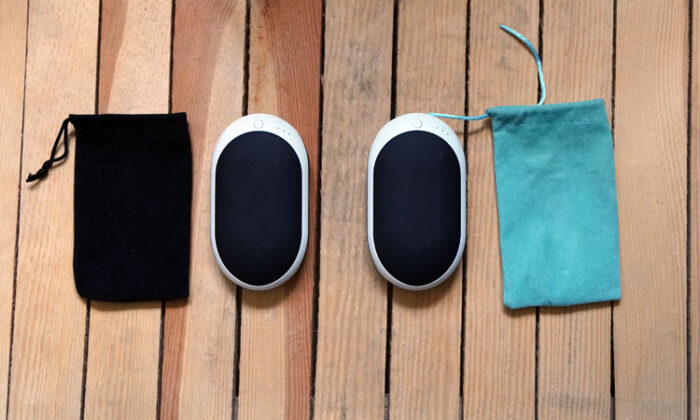
When the hand warmer arrived, the first thing I noticed was that Ocoopa are sponsors of the Raynaud’s Association. Even before I opened the box, that was a confirmation that I had possibly made the right choice. The hand warmer arrived in a nice box with a pouch and USB cable and instructions leaflet alongside and a card from Raynaud’s Association. Also included, I thought was a little ‘Best Wishes to You’ card and a love heart sticker, a really nice little touch. Even though the product was made in China, this definitely gave the impression that by buying their product, you must have been a part of the Raynaud’s family and community. A lovely gesture.
One of the benefits of the hand warmer was that if I wasn’t using the device as a hand-warmer, I could use it as an extra battery pack for my phone, which is always handy.
I had bought the Ocoopa RHW PowerPlus Edition, ZLS-A8 model, which has a battery capacity of 7800mAh and weighs in at 190g. It also has three cable options for charging.
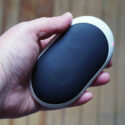
The design was sleek, with a different texture on the heated pad portion of the hand warmer, making it easier to grip. There are three little LEDs on the hand warmer. When red, they indicate the level of heat being produced and when you’re charging the device, they flash blue showing the charge level.
I found it to be comfortable in the palm of my hand and just the right size to hold on to. So far, so good! But what about the heat?
I switched on the device as I was leaving work, it would take an hour to reach home. The heat settings ranged from hot to comfortably warm. By the time I got home, I went online to order a second one.
These things are awesome. The heat lasted at least 2 and half hours. One for each hand makes for a more comfortable outing on a winter’s day. I did find that one of them gets slightly hotter than the other and once the hand warmer heats up (only takes a few seconds), the first or middle settings were enough. Three lights on was too much for me.
The idea of these things isn’t to roast your hands. If you have Raynaud’s, you don’t want extremes. For me, if my hands get too hot, they swell up. It’s all about moderation.
Even in the depth’s of winter, I found that when I was freezing, and wearing gloves, the middle setting was enough once I got my hands warmed up.
The hand warmers are not heavy and are charged through a USB cable. They take about 2 to two and a half hours to charge and stay warm for at least three hours. I’ve turned on the hand warmers as I was leaving the house, turned them off when I get to work and they are also good for the return journey. I’ve also used them after that without charging up. That’s at least two and a half / three hours.
I’ve also used the hand-warmer as a phone battery pack. It’s really handy to have in an everyday backpack or handbag. I get about one and a half phone to two full charges from each.
I genuinely didn’t know that the Raynaud’s Association had endorsed this product. I chose it as it was affordable and a safe option to use on public transport and at work and just seemed right for what I needed.
The Ocoopa Rechargeable hand warmer gets two toasty thumbs up from me!
This isn’t a sponsored post, I bought both handwarmers myself. However, the image on the right is an affiliate link, meaning if you decide to purchase the handwarmer, I get a little cut, without costing you anything.
I know it took me a while to find something that would work for my Raynaud’s, hopefully this will work for you.
September 1 2013. I didn’t really sleep. I dozed off a few times but just for twenty minutes here and there. I woke up again as the coach thundered through Finchley, passed the famous Baker Street, before reaching Victoria Coach Station.
I took the Coach and Sail. It cost 50 euro. I arrived in London Victoria from Dublin before 8am on a Sunday morning. So early that some of the tube stations weren’t open yet. I had one large suitcase, along with my laptop, microphone and cables, my audio recorder and my mixing desk. Just the essentials. I had booked some temporary accommodation in Walthamstow and was to start a new job the following day.
Moving to London wasn’t an easy decision. We had lived here from 2001-2002 and I hated it. After finishing my degree in Dublin City University in 2012, I managed to get two interviews, both for part time work. Ireland wasn’t a particularly fun place after the recession. Staying in Ireland was becoming a lot more difficult for us, with one proper wage coming in. We had to take a chance.
It wasn’t an easy move. I had applied for a job and got it. Tahlula was still working in Ireland. We would be apart for two months. We sneaked in weekends but it’s not the same. New city, going ‘home’ to temporary accommodation, not knowing too many people. Thank Alanis for the internet!
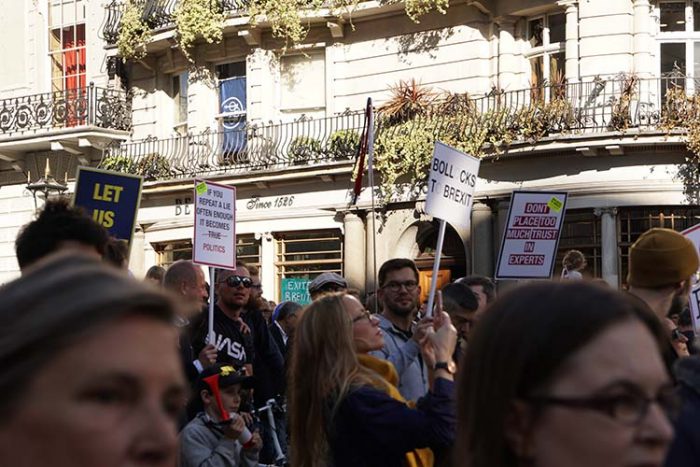
By early 2014, we had settled more into life in London and had moved into a proper apartment. I hated the trains then, I hated the trains now. Since then, we’ve gone home to vote for Marriage Equality. We’ve been here through the Brexit campaign and the ridiculousness of the UK voting itself out of the EU. We been through a redundancy and the urgency of needing a job in London. We’ve avoided far right rallies in Central London on a Saturday, we’ve wandered into Remain marches when a million people turned up. And we’ve been here through this Covid-19 pandemic.
People will say London is only an hour from home. While it’s realistically a little bit further, right now it could be ten hours away. We’re both lucky enough to know that our parents and families are safe in Ireland and that we’re safe here. It just happens that this is the longest we’ve been away without going home. Going home to visit isn’t an option right now. It makes the approximate 500 kilometres seem like 5000.
There are so many familiars between here and Ireland. The telly is the same. You can get RTE on the internet. The food is the same. There are Irish shops around and I’ve even recently been able to get my beloved Lyons Gold Blend Tea Bags delivered. There are so many Irish accents around. But, the post boxes are red, not green. While you might know other people living in London, the city of eight million is so big, you’ll never bump into them. Depending on where you live, you might see them twice a year.
The hardest part is trying to balance keeping in touch with what’s happening in London, with your life in London. It’s very easy to get lost in the comfortable surroundings of online life in Ireland. Social media makes it extremely easy to stay on top of what’s happening at home but you can’t always look back. You have to live in the now.
I don’t have that ‘London is home’ feeling about the place. In what was the old normal, there were always lots of places to see, things to do, gigs to go to. It’s great that, if you want, there are all these things on your doorstep. But London is an expensive city. Going outside the door always seems to cost twenty quid. Living in South East London means more greenery, cheaper rent and a bigger apartment. It also means watching for the last train to ensure you don’t end up on a dreaded night bus. But with saving £500 a month in rent, it’s something I’m more than happy to put up with.
I’ve never liked commuting, I think it’s a waste of life. The stress of squeezing onto a train. No! Just, no! What the world has taught me in the past six months is that we need to enjoy our time, lead a more sustainable life. We genuinely think of ourselves and our lives more than we do of our jobs and taking part in a rat race. I think for me, there are too many people in London.
In 2016, I wrote that I didn’t know how long I would be in London for. I still don’t know but it’s not where I want to be forever. I could write a list of plans and dreams but I’ve learned that life isn’t like that. The pandemic obviously has changed time frames on everyone’s lives for now. I still have plans and aims, long term though, I’m not really sure if London will fit in.
You’re hoping to get an Irish passport? Your parent has one, your grandparent was born in Ireland, so you want to apply to get one. Can you get one?
The answer isn’t as straightforward as you may hope. But, eventually, you will be able to apply for an Irish passport.
You may think that doesn’t really make sense. In this post, I’m going to go through what you need to do and show you how to get yourself in a position to apply for an Irish passport.
You need to apply for Citizenship!
There are a couple of things you need to consider.
You need to be an Irish citizen to apply for an Irish passport. Passports can only be held by Irish citizens.
If you want to apply for a passport through your Irish born grandparent and your parent was born outside Ireland, you are not an Irish citizen. You need to apply for a Irish Citizenship before you can apply for a passport. It all comes down to who was born in Ireland.
It doesn’t matter if your parent holds an Irish passport, just because they hold an Irish passport doesn’t make YOU an Irish citizen.
There are other scenarios where you need to Register a Foreign Birth (For example, if your parent was a naturalised Irish citizen and you were born outside Ireland) but this post will only deal with applying for citizenship through an Irish born Grandparent.
Foreign Birth Registration, in itself, is a straightforward process but you need to have all the information you need to hand before you start the application.
As you are applying through an Irish born grandparent you will need documentation to show your family tree from your grandparent to you. That means you will also need your parent’s details.
Documents needed
These are the typical documents needed when Registering a Foreign Birth. Major Caveat, you may be asked for more documentation or slightly different documentation depending on your circumstances (eg adopted).
Documents Needed for The Applicant
Your original long form Birth certificate
If you’re married, original Marriage Certificate
If you’ve divorced and remarried: Divorce Decree / New Marriage Certificate
Certified Copy of your current Passport*
Proof of Name and Address. You need 3 documents showing your name and address. These can be Council Tax bills, utility bills, bank statements, P60s etc.
If you’ve Changed your name by Deed Poll, you need to submit the original and two documents showing your proof of usage of your new name for at least two years. Your Deed Poll must be valid for at least two years.
If the applicant is a minor, you will also need:*
Certified Copy of your current Passport* and a letter from school or Doctor confirming the child is a registered student or patient
One proof of address from the country in which they are resident
Two proofs of current residence from the minor’s parent
*Please note that this scenario is if the person applying for the minor is their Irish citizen parent.
As Ireland is not your place of birth and you are applying for citizenship, you would normally hold a passport from another country.
Documents Needed For The Applicant’s Irish Parent
Parent’s original long form birth certificate
If you’re married: original Marriage Certificate
If you’ve divorced and remarried: Divorce Decree / New Marriage Certificate
Certified Copy of your current Passport or If your parent is deceased: Original Death Certificate
If they’ve changed their name by Deed Poll, you need to submit the original and two documents showing your proof of usage of your new name for at least two years. Your Deed Poll must be valid for at least two years.
Documents Needed for Irish-Born Grandparents
If you’re married, original Marriage Certificate
If you’ve divorced and remarried: Divorce Decree / New Marriage Certificate
Certified Copy of your current Passport or If your grandparent is deceased: Original Death Certificate
If they’ve changed their name by Deed Poll, you need to submit the original and two documents showing your proof of usage of your new name for at least two years. Your Deed Poll must be valid for at least two years.This is not an exhaustive list, you may be asked for further details.
Never send your valid passport with the Foreign Birth Application, always get your witness to certify / notarise a copy and send that.
Once you’ve got all your documents together, you can start the actual application. It’s an online process and there is no definite time frame as to how long the actual process takes. It could take a year or more.
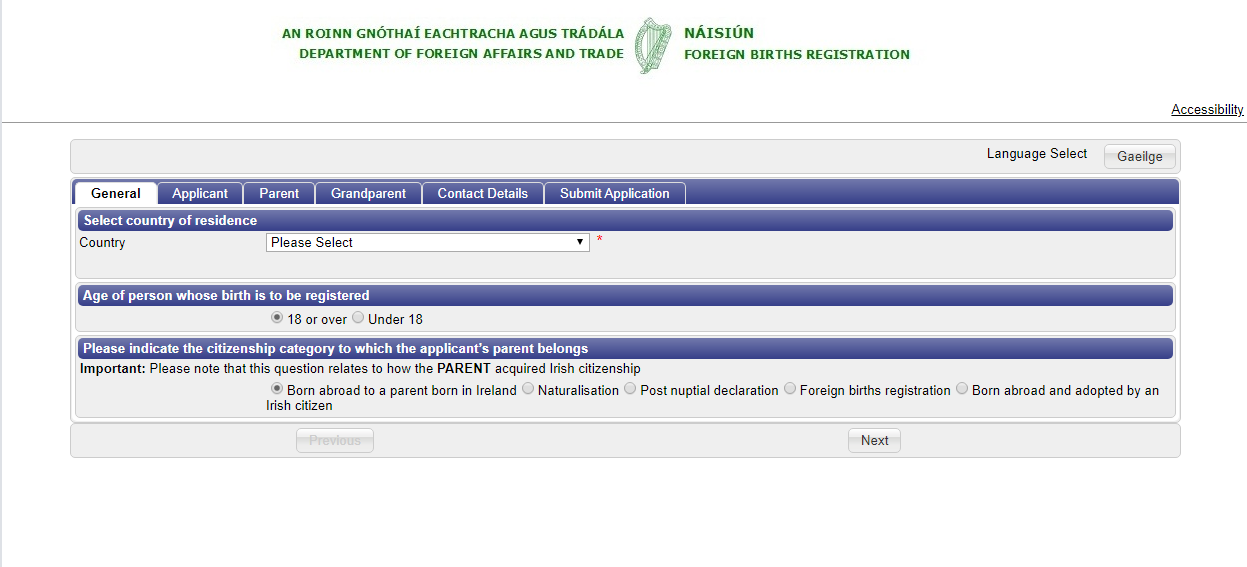
It’s all really simple from here. You’ll notice tabs on the application form for the applicant, parent and grandparent and then, of course, your contact details.
The first thing you’ll notice is that there are a number of options for ‘Please indicate the citizenship category to which the applicant’s parent belongs‘. This trips people up a little. The default is ‘Born Abroad to a Parent Born in Ireland’, if you are applying this way, leave it in the default setting. Look at it this way – like a family tree.
Irish Born Grandparent
vvvv
Irish Citizen Parent – Born Abroad to a Parent Born in Ireland
vvvv
Applicant
All you need to do then is fill in the ‘Irish Citizen Parent – Born Abroad to a Parent Born in Ireland’ details and the ‘Irish born Grandparent’ details.
Screenshot of Foreign Birth Registration page on the DFA website
Once you go through the the online form, and you submit the application, you will need to print off a pdf which is populated with all your answers. From this your witness needs to sign the Certificate of Identity.
Once you have everything compiled, send it to the address stated on the pdf. Make sure you send it by Special Delivery (from the UK) or equivalent so you can track that all your documents have been received.
Once you do this, it’s now waiting time.
When the process is complete, you will receive a Foreign Birth Registration Certificate which confirms you are an Irish citizen. Now, you can apply for a passport.
Good luck! Always contact your local Embassy or Consulate for any advice.
Nessymon.com takes no responsibility for any errors, omissions or changes that may happen to this process. Always contact your local Embassy or Consulate for advice.